
Why Is My Water Heater Leaking From the Bottom in Palm Coast, FL, and Do I Have Minutes or Days?
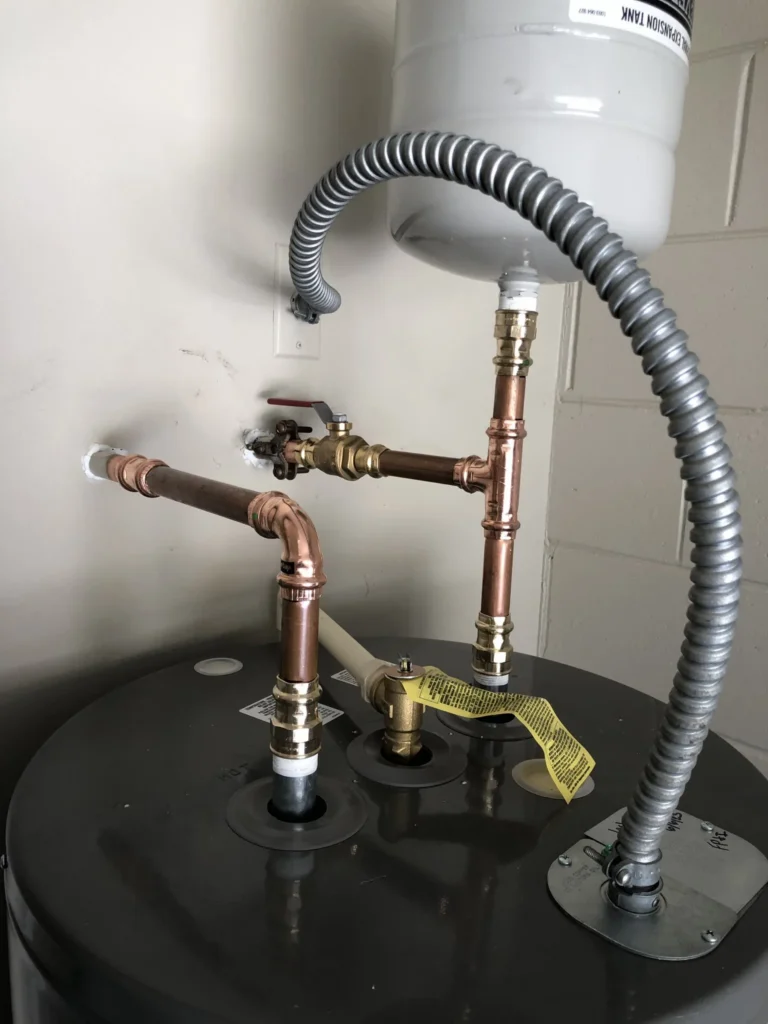
- Water at the base of a tank comes from one of four places: a fitting on top, the relief valve, the drain valve, or the tank itself. Only the tank is beyond repair.
- Breaker off, then the cold-water valve on top of the tank. Those two steps turn a running problem into a waiting one.
- A tank-body leak on an older heater is a replacement, and the real deadline is the drywall and the floor, not the heater.
- Florida gives you one year from the date of loss to report a property claim. Photograph the tank, the date code and the wet wall before cleanup.
The situations described here are composites drawn from the types of jobs and decisions we encounter regularly. Names and specific figures are illustrative.
An eleven-year-old, 50-gallon electric water heater in a Palm Coast garage had a puddle spreading out from under it, and the homeowner wanted to know two things: was it the tank, and how long did she have. That is the usual shape of a water heater leaking from the bottom in Palm Coast, FL call. The answer turned out to be the tank, and the deadline turned out to be the drywall behind it, not the heater itself.
This post follows that job in order: what we had her do on the phone, how we found the source, and why an older tank on hard water ends this way. We updated it in fall 2026 with the current Florida plumbing code language on pans and relief-valve lines, and the current state deadline for reporting a claim.
What we had her do before we got there
First, the power. This house was all-electric, like most of the homes we work in around Palm Coast. On an electric heater the first shut-off is the breaker, not a valve. She found the double-pole breaker labeled for the water heater and switched it off. A.O. Smith’s own guidance on leaking heaters puts this step first: turn off the breaker for an electric unit, or the gas valve on a gas one, before you inspect anything.[1] An element that keeps heating while water drains away from it is how a leak turns into a burnt element on top of everything else.
Second, the water. Same guidance, step three: close the dedicated shut-off on the cold line going into the heater.[1] On her tank that was a quarter-turn ball valve on the copper line above the inlet. On older installs it is often a round-handled gate valve that has not been turned in years and may not close all the way. If that valve will not move, the main shut-off for the house does the same job. Opening a hot tap somewhere in the house lets the pressure off the tank.
Four places the water can come from
When we got there we dried the top of the tank and every fitting with paper towels and watched. Water runs down, so a leak up top often looks like a leak at the bottom by the time anyone sees it. The manufacturer’s guide sorts leaks the same way we do, by where they show up: top, side, or base.[1] Here is how that looked laid out for her:
| Where the water shows up | Usual cause | What it usually means |
|---|---|---|
| Wet trail down the jacket from the top | Loose or corroded inlet/outlet fitting | Repairable: tighten or replace the fitting[1] |
| Relief valve on the side, or its discharge pipe | Temperature or pressure too high | Repairable: find the cause; an expansion tank or a new valve[1] |
| Drain valve at the bottom front | Valve not sealing | Repairable: replace the drain valve[1] |
| Base of the tank, from under the jacket | Corroded tank | Not repairable: replace the heater[1] |
The top was dry. The relief valve discharge line was dry. The drain valve was dry. The pan under the tank had about a quarter inch of water in it, and a flashlight along the bottom seam of the jacket showed rust stain coming through from the inside. That is the fourth row. A.O. Smith describes a leak from the base as often the first sign of a serious internal problem such as a corroded tank, and notes that corrosion of that kind cannot be repaired.[1]
For context, the side leak is not always the valve’s fault. A relief valve that drips is often doing its job because the pressure or temperature in the tank is too high. If the cause is pressure, a properly sized expansion tank is the fix the manufacturer points to.[1] We go through what that adds to a bill in what an itemized water heater quote in Palm Coast includes, line by line. A different garage, where the pan was wet and the cause turned out to be that valve, is the story in a 13-year-old tank with a wet pan in Palm Coast.
Why an eleven-year-old tank on hard water ends this way
The date code on the rating plate put the heater at eleven years old. A.O. Smith gives a range of 8 to 20 years for water heaters depending on the type, and says the sacrificial anode rod that protects a tank from rust usually lasts 3 to 5 years before it needs replacing.[1] This tank had never had its anode checked. By year eleven there was very little left protecting the steel.
Hard water speeds the rest of it along. Minerals settle at the bottom of the tank, and the manufacturer lists that sediment as a cause of overheating, cracks and leaks, and specifically as a likely cause when a tank leaks from the bottom.[1] The USGS classifies water above 120 milligrams per liter of hardness as hard and above 180 as very hard.[3] We looked at where Palm Coast city water sits on that scale in what the city’s water quality report says about hardness, and how that plays into tank life in how long water heaters last in Florida garages.
So the driveway conversation was not repair or replace. It was how soon. The bottom edge of the drywall behind the pan was already dark. Water that sits against the paper face of drywall in a Florida garage does not stay a water problem for long. With the water off, the tank could have waited until Monday. The wall could not.
The pan, the relief line, and what the code says now
When we pulled the old tank, the pan under it had never been piped anywhere. It caught water, but nothing carried the water out or made it visible. The Florida Building Code, Plumbing, 8th Edition (2023), requires a pan under a tank-type water heater anywhere a leak would cause damage, at least 1-1/2 inches deep and drained by a pipe at least 3/4 inch in diameter.[2] The drain has to end over a floor drain or waste receptor, or outside the building 6 to 24 inches above the ground.[2]
There is one detail homeowners are often told wrong. The same section says that where a pan drain was not installed before, a pan drain is not required for a replacement water heater.[2] So on a straight swap, a drain line is not automatic. In her garage the exterior wall was right there, so running one was a short job, and she chose it.
“The code wants a pan under a tank water heater anywhere a leak would do damage, and that pan gets a drain at least three-quarters of an inch. Where there was never a drain line before, it isn’t required on a replacement, so on a swap it is a choice worth talking through.[2]“
Christian Laymon, Master Plumber and Owner, Florida Plumbing & Inspection
The relief valve line got the same attention. The code says that discharge pipe cannot be trapped, has to drain by gravity, has to end somewhere the people in the house can see it, and has to end no more than 6 inches above the floor or the rim of the waste receptor.[2] Hers ended in a wall cavity, which meant a dripping valve could have gone on for months without anyone noticing.
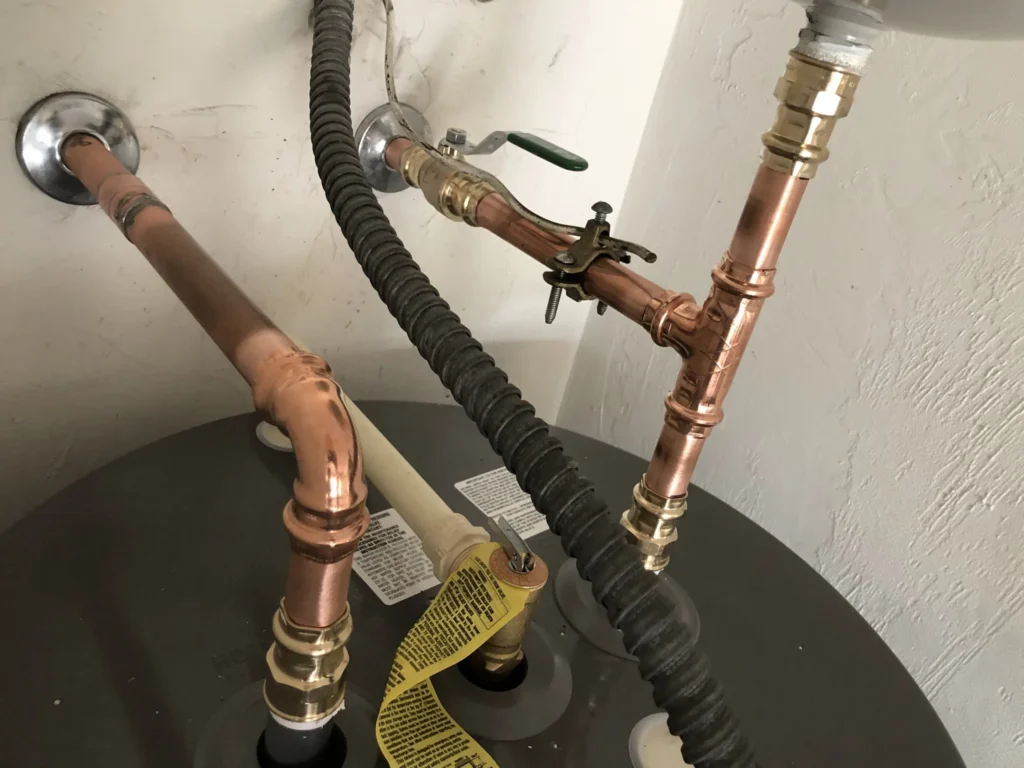
The rest was a like-for-like electric replacement on the existing circuit: new 50-gallon tank, new pan with a drain line to the outside wall, an expansion tank because the house had a pressure-reducing valve, and a new relief line run to the pan. The full day, from the first call to hot water, was about six hours including a parts run. That is not always possible. How we handle replacements, including the pan and relief line, is on our water heater installation and repair service in Palm Coast page.
Here is how her day actually went, laid out the way we described it to her afterward:
| Time from first call | What happened | Why it mattered |
|---|---|---|
| 0 to 10 minutes | Breaker off, cold valve closed, hot tap opened | Stopped the element from running dry and stopped new water feeding the leak |
| About 1 hour | Fittings, relief line and drain valve checked dry; rust found at the bottom seam | Ruled out the three repairable sources |
| About 2 hours | Photos of the tank, rating plate, pan and wall; old tank drained and removed | Evidence for a claim and a dry wall to start drying |
| About 6 hours | New tank, pan drain, expansion tank and relief line in; hot water back | Wall drying started the same day instead of after a weekend |
The insurance question while the old tank went on the truck
She asked whether her homeowners policy would cover any of it. We are not adjusters, and the answer depends on the policy wording. Two things are not up for debate. First, Florida law bars a new property claim unless notice is given to the insurer within one year after the date of loss.[4] Second, the claim goes better with evidence: photos of the puddle, the tank’s rating plate, the rust at the seam and the wet drywall, taken before cleanup, plus the invoice.
In our experience, an adjuster treats a tank that wore out as the homeowner’s cost and looks separately at the water damage around it. The age of the heater also comes up at renewal, which is a different conversation, covered in why a four-point inspection flagged a working tank in Flagler County.
What people usually ask at this point
Can a leaking water heater be repaired? If it is a fitting, the relief valve or the drain valve, yes, and it is usually a short visit through our plumbing repair and service calls in Palm Coast. If the water is coming from the tank body, no. There is no patch for a corroded steel tank that lasts.
Do I have minutes or days? With the breaker off and the cold valve closed, the tank itself is not going anywhere fast. What sets the clock is where the water has already gone. A dry pan with a drain line buys days. Water against drywall or under baseboards is a same-day or next-day job.
Is it dangerous? The water is a damage problem. The risk is an electric element running while the water level drops, and water near the electrical connections on top. Turning off the breaker first takes care of most of that.
If you want the wider picture, this job is one of the decisions in the guide built from four Palm Coast water heater calls in one week.
What that garage showed
The water on the floor was the least important thing in that garage. The age of the tank, the unchecked anode, the undrained pan and the relief line hidden in a wall had been there for years. If your heater is past ten years old, a flashlight along the bottom seam and a look into the pan takes a minute. A dry pan and a clean seam mean a replacement can be planned. A rust-stained seam means you are where she was, a few weeks earlier.
If you are dealing with a water heater leaking from the bottom in Palm Coast, FL question right now, you can reach out here, through our water heater repair and replacement page.
Sources
- Why Is My Water Heater Leaking? How to Diagnose, Fix, and Prevent Water Heater Leaks, A. O. Smith
- Florida Building Code, Plumbing, 8th Edition (2023), Chapter 5: Water Heaters, Sections 504.6 and 504.7, Florida Building Commission (via UpCodes)
- Hardness of Water, U.S. Geological Survey Water Science School
- Florida Statutes 627.70132: Notice of property insurance claim, The Florida Senate (2025)