
Common Household Plumbing Problems in Palm Coast: What Did One Week of $96 Service Calls Teach Us About What Breaks and What It Costs?
- Most of what breaks in a Palm Coast house is small, predictable, and caused by the same three things: hard water, salt air, and parts that were installed in the 1980s and 1990s and never replaced.
- Five calls in one week: a running toilet, a snapped hose bib, a jammed disposal, a dripping faucet cartridge, and a main shut-off that would not close. Each one walked from the door to the invoice.
- Every visit starts with a $96 service call that is applied to the repair. Most of these tickets landed between $150 and $450.
- For each problem: what you can safely try first, what I check when I arrive, and where the line is between a homeowner fix and a call.
The situations described here are composites drawn from the types of jobs and decisions we encounter regularly. Names and specific figures are illustrative.
I keep a log of every call, and one week in late spring is the one I hand to new customers who ask about the common household plumbing problems in a Palm Coast house. Monday was a running toilet in Seminole Woods. Tuesday a hose bib snapped clean off a stucco wall by a rented pressure washer. Wednesday a garbage disposal that hummed and tripped. Thursday a kitchen faucet dripping again six months after a new cartridge. Friday a main shut-off valve that would not turn, found by a four-point inspector. Nothing dramatic, nothing that made the news, and together they are a better guide than any list I could write from memory, because every one of them has a cause that is specific to here.
This guide walks each of the five calls in order, from what the homeowner described on the phone to what the invoice said. For each one I cover what causes it in Palm Coast specifically, what you can try before calling, what I do when I arrive, and what it cost. The eight shorter posts linked throughout go deeper on each problem and on the ones that did not happen that week but happen every month.
Why Palm Coast houses break the way they do
Three things. The first is the water. City water here comes from wells and, after treatment, runs about eleven grains per gallon of hardness according to the City of Palm Coast Annual Water Quality Report[1], which the USGS classification[2] calls hard. Hard water leaves scale on everything it touches: fill valves, faucet cartridges, water heater elements, disposal chambers, and the inside of every valve. Most of what I replace on a service call is a part that scale has stopped from moving or sealing.
The second is the air. Palm Coast sits a few miles from the Atlantic, and salt aerosol reaches most of the city on an east wind. Anything brass or steel outside a wall, which means hose bibs, main shut-offs at the front stub, irrigation backflow preventers, and the fittings on outdoor water heaters, corrodes years faster than it would inland. The hose bib that snapped on Tuesday was twenty years old and had the wall thickness of a soda can.
The third is the housing stock. A large share of the city was built by ITT in the 1970s and 80s and by production builders in the 1990s and 2000s, with the same parts in thousands of houses: multi-turn gate valves at the main, compression stops under sinks, copper under the slab, builder-grade faucets and disposals. Those parts are now thirty to fifty years old in houses where nobody has replaced them, and they are all reaching the end of their lives at once. When I say a problem is common, I mean I have fixed the same part in the same location in a hundred houses that share a floor plan.
Monday: the toilet that kept running, Seminole Woods
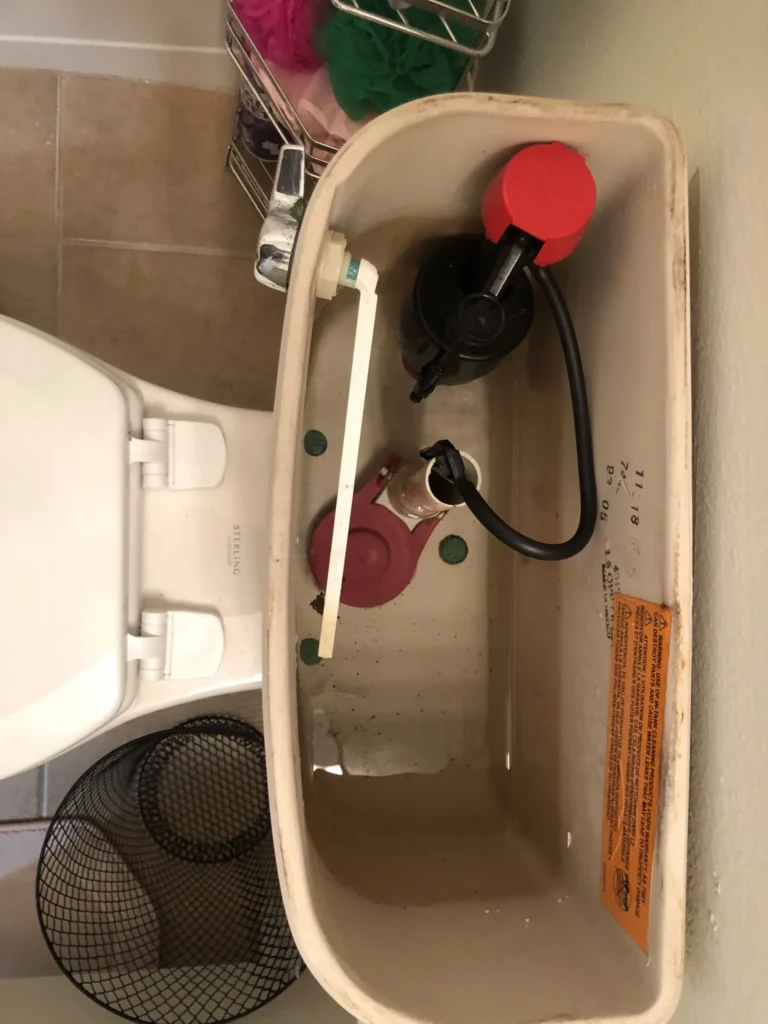
The call: a toilet refilling itself every twenty minutes all night, and a homeowner who had already replaced the flapper twice. This is the most common household plumbing problem I see, and the version where the homeowner has already tried the obvious fix is the most common version of it.
What causes it here: two things, usually together. A fill valve crusted with mineral scale so it no longer shuts off cleanly, and a replacement flapper that does not match the flush valve seat, which is almost always a two-inch flapper on a three-inch valve. Fluidmaster[3]‘s fitting guides are clear that flappers must be matched to the valve size, and the word universal on the package is a starting point, not a promise.
What to try first: food coloring in the tank, wait ten minutes, look in the bowl. Color means the flapper is passing. Listen at the tank for a hiss, which means the fill valve is running. Check the water level against the overflow tube; it should sit about an inch below the top.
What I did: measured the flush valve, installed a matched three-inch flapper, pulled the fill valve cap and found it scaled, replaced the valve, set the level, and replaced the twelve-year-old braided supply line while the water was off. Twenty minutes. The ticket landed in the $150 to $200 range with the $96 applied. EPA WaterSense[4] puts a running toilet at up to two hundred gallons a day, so three weeks of this one had cost more in water than the repair. The full diagnosis, step by step, is in the post on what to do when the toilet keeps running after you already replaced the flapper.
Where the line is: flapper and fill valve are homeowner jobs if the shut-off under the toilet actually shuts off. Anything that involves lifting the tank is a call.
Tuesday: the hose bib snapped off by a pressure washer
The call: water spraying from the front wall of the house, the homeowner had found the meter and shut it off at the street, and the hose bib was in his hand. He had rented a pressure washer for the driveway and connected it to the front sillcock. The pressure washer’s pump pulls hard on the supply and vibrates; the brass sillcock, corroded thin by twenty years of salt air, cracked at the threads inside the wall and then broke off when he tried to close it.
What causes it here: the air. A hose bib on the east or north side of a Palm Coast house, exposed to the wind off the ocean, loses wall thickness from the outside in. The green crust on an old sillcock is the visible part; the thinning is not visible until it fails. The U.S. Consumer Product Safety Commission[5]‘s guidance on pressure washers mentions supply connections mostly for the risk of the hose whipping, but the practical advice is the same: check the bib before you connect a pump to it.
What to try first: nothing, on a broken one, except shutting the water off. On an old one that has not broken yet, turn it on and off and look for a drip at the stem or a wobble in the body. Either one means replace it before something puts load on it.
What I did: cut the old stub back to clean copper inside the wall, installed a new quarter-turn frost-free sillcock with a vacuum breaker, anchored it with stainless screws, sealed the stucco penetration, and while I was there checked the other three bibs on the house and found one more that wobbled. Replaced it too, on the same service call, which is the cheapest way to fix the second one. Forty minutes for the first, fifteen for the second. The first landed in the $150 to $250 range; the second was parts and a short labor line, since the trip was already paid for.
Where the line is: replacing a hose bib is a call, because it involves soldering or a push fitting inside a wall and a stucco patch, and because a bad job here leaks inside the wall.
Wednesday: the garbage disposal that hummed but would not spin
The call: Sunday dinner, disposal hums, trips off, reset button pressed, hums and trips again. The homeowner had done the reset, which is more than most, and had not done the hex wrench, which is the step that matters.
What causes it here: a jam, almost always. A hum means the motor has power and the flywheel is locked against something. That week it was a peach pit. Most weeks it is a pit, a bone, a piece of fibrous vegetable, or occasionally a piece of a wine glass or a ring. Hard water plays a part on older units by scaling the grinding chamber so that objects catch more easily.
What to try first: breaker off. Quarter-inch hex wrench in the socket on the bottom of the unit, which InSinkErator[6] ships with every disposal and which fits any brand. Rock it until the flywheel turns through. Tongs for the object, never fingers. Press the reset. Run cold water and test. This is a five-minute homeowner job and I say so on the phone.
What I did: the unjam, which took four minutes, and then a flashlight under the unit, which found moisture at the housing seam and a hairline crack above it. A twelve-year-old disposal with a cracked housing is not repairable; the seal and housing are not serviceable parts. I told the homeowner the unjam would hold a week and that a wet cabinet floor was coming. She chose a new half-horsepower unit, installed the next morning in under an hour, with the trap and dishwasher connection checked while the sink was open. That ticket landed in the $275 to $450 range with the unit, which is most of it. The story, with the rule I use for repair versus replace, is in the post on whether a garbage disposal humming but not spinning is worth fixing. A seasonal return can raise a different question; the article on an unused guest shower and a Palm Coast sewer smell distinguishes an odor near one fixture from broader drainage symptoms.
Where the line is: jam, reset, and a leaking sink flange are yours. A leak from the body, repeated trips with an empty chamber, or a unit past twelve years is a replacement.
Thursday: the faucet cartridge that lasted six months
The call: kitchen faucet dripping again, six months after a cartridge fixed the same drip. The manufacturer would ship a free cartridge; the homeowner wanted to know whether to use it.
What causes it here: the water, again. A cartridge seals against a machined brass bore in the valve body. Grit from hard-water scale, carried through the faucet for twenty years, scores that bore. A new cartridge seals against the scratches while its rubber is soft, then leaks as the rubber takes a set. Moen[7] and Delta[8] both publish hard-water service guidance and both warrant the cartridge, not the body. On soft water a cartridge lasts fifteen years. Here, five to seven on a new faucet, and months on a scored one.
What to try first: pull the cartridge yourself, if the stops under the sink turn. Look at the seals; if they are intact, shine a light in the body. Scratches or scale in the bore mean the faucet is done. A smooth bore means a new cartridge is fine.
What I did: pulled the six-month-old cartridge, found it intact, found two longitudinal scores in the hot side of the bore, and showed the homeowner with a light. She chose a new pull-down kitchen faucet with a ceramic-disc valve, which is what I recommend on this water because ceramic discs are harder than the grit and do not score. Installed with new supply lines, since the old braided lines were as old as the faucet, and confirmed the new faucet met the EPA lead-free rule[9], which is the NSF/ANSI 372 standard for wetted brass. The ticket was the service call applied to the install plus labor in the $175 to $275 range, with the faucet bought by the homeowner from a short list I texted. The five-minute look inside the valve body, and the rule for when a second cartridge is worth it, is in the post on whether to replace the faucet cartridge or the whole faucet.
Friday: the main shut-off that would not shut off
The call: a four-point inspection on a 1988 house had flagged corroded gate valves under every sink and a main shut-off the inspector could not turn, and the carrier had given the homeowner thirty days. This is the least urgent call of the week by water and the most urgent by calendar.
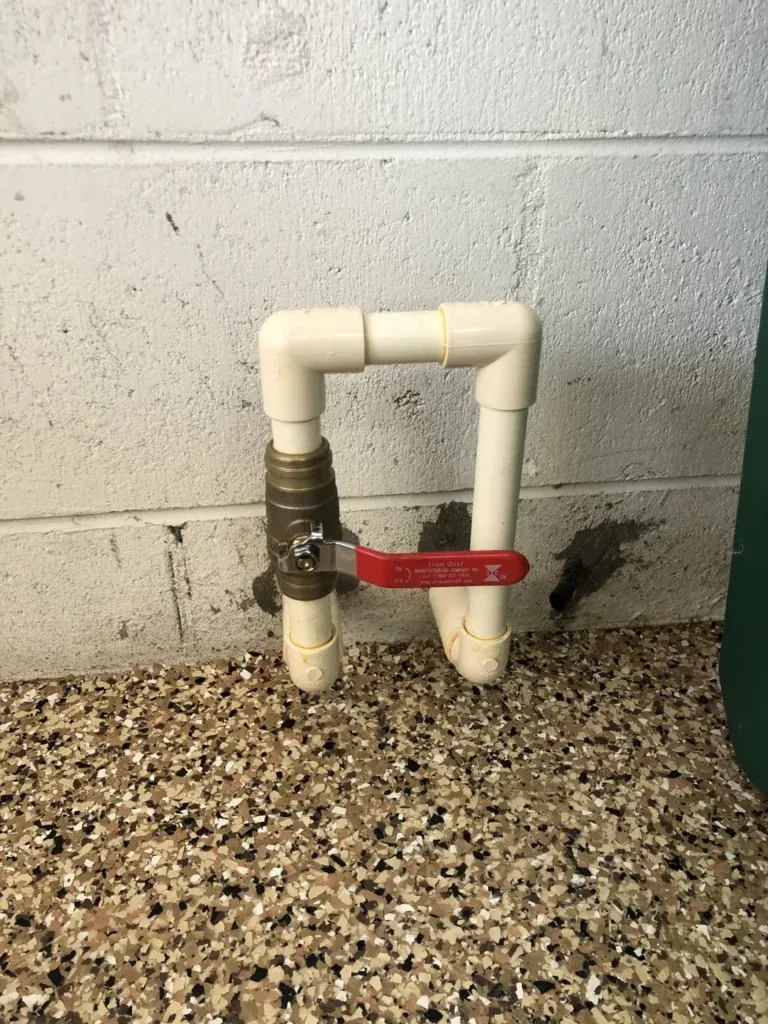
What causes it here: age and the air. The original 1988 valves were multi-turn compression stops at the fixtures and a wheel-handle gate valve at the main, on the front stub outside the wall. Hard water scales the stems until they will not turn; salt air corrodes the gate until it drops off the stem and the wheel spins uselessly. An underwriter reads a main that will not close as a water loss waiting to happen, which is why the Citizens Property Insurance[10] four-point form asks about it and why the Florida Office of Insurance Regulation[11]‘s guidance for homeowners explains that the form drives the underwriting decision.
What to try first: find your main and turn it. Gently. If it is a gate valve that fights, stop; forcing it snaps the stem. Check the stops under each sink the same way. Any that will not turn or weep at the stem when they do are on the list.
What I did: water off at the meter with a curb key, drained the system, replaced the main gate valve with a full-port ball valve and a union, replaced all eleven fixture stops with quarter-turn ball-valve stops and new braided supply lines, turned the water on, and photographed every valve open and dry with a location label. The invoice named the four-point findings and stated they were corrected, and the homeowner’s agent sent the invoice and photos to the carrier, which renewed without a second visit. One morning. The main was in the $250 to $400 range and the stops were a per-valve parts-and-labor item, all under one service call. The Florida Building Code, Plumbing[12] edition requires a full-way valve on every building’s water service, and a ball valve is how everyone meets it now. The whole four-point, from the letter to the renewal, is in the post on what insurers look for in shut-off valves during a four-point inspection.
What the week did not include, and happens every month
Five calls is a sample, not the whole list. The problems below did not come up that week and come up constantly, and each has its own post.
A water bill that triples with dry floors. The water is going somewhere you cannot see: a toilet, an irrigation lateral, or under the slab. The meter at the curb tells you in five minutes whether the house is leaking right now, and the order to check after that is toilets, irrigation, then the house main. That elimination process, on a house where the answer was 9,000 gallons under a hall bathroom, is in the post on why a water bill is suddenly high with no visible leak.
A warm spot on a tile floor. In a slab house with copper under the concrete, a warm patch means a hot line leaking into the sand. The signs, the detection, and the decision between breaking the slab and rerouting the line through the attic, on a 1994 house in the L-section where the reroute won, are in the post on the signs of a slab leak in a Florida home. Insurance under Florida Statute 627.7011[13] typically covers the access and the damage, not the pipe, and the SB 2-A[14] reforms shortened the reporting window, so document early.
A supply line that lets go while nobody is home. Braided toilet and sink supply lines are a ten-year wear part, and when they fail they fail at full pressure. The seasonal resident whose guest-bath line burst in July, whose neighbor could not find the shut-off, and the twenty-minute walkthrough I now do with every snowbird before they leave, is in the post on where the main water shut-off valve is in a Florida house.
Water pressure that is too high or too low. Palm Coast’s municipal pressure varies by section and by the age of the pressure-reducing valve at the house. A PRV that has failed high makes every fixture in the house work harder and is the hidden cause behind a lot of the supply-line failures above. A PRV that has failed low makes the shower miserable. Either is a same-day repair and a modest ticket. Before anyone prices a booster pump, two gauge readings, one before the PRV and one after, will show which side of the valve the problem is on; that is how a Cypress Knoll house got its shower back, in our post on what was really behind a weak shower when the homeowners were ready to buy a booster pump.
Hot water that runs out, or does not run at all. That is its own category and its own guide, but the short version for a service call is that an electric tank with lukewarm water usually has a failed lower element, which is an hour and a low-$200s ticket on a tank young enough to be worth it. Above about twelve years, the conversation changes to replacement, and I quote both.
What the five invoices add up to
Laid side by side, the week’s tickets landed between about $150 and $450, with the $96 service call inside every one, never on top. Roughly forty percent of the total across the five was the trip and the diagnosis, thirty-five percent was parts, and a quarter was the labor to install and test. That is the shape of small-repair pricing everywhere, and the way to lower it is not a cheaper hourly rate, which I do not charge, but batching: three problems in one house is one service call. The five invoices, with the three questions to ask any plumber before they come, are laid out in the post on how much a plumber costs in Florida and what five Palm Coast service calls actually came to. Florida Statute 489[15] requires a state license for the person doing this work, and the DBPR license lookup[16] will confirm the one on the truck in a minute.
What to keep on hand, and what to check once a year
A quarter-inch hex wrench taped inside the sink cabinet. Food coloring for the toilet tank. The location of the main shut-off and the meter box, with a photo on your phone. That covers most of what you can do yourself. Once a year: turn every stop under every sink and behind every toilet, and turn the main, gently; any that fight or weep go on a list. Look at every braided supply line and replace any you cannot date. Turn each hose bib on and off and look for a drip at the stem. Open the cabinet under every sink and touch the bottom. Twenty minutes, once a year, and most of the calls in this guide never get made.
What people ask most, in one place
What are the most common plumbing problems in a house? Running toilets, dripping faucets, jammed disposals, corroded hose bibs and shut-off valves, and hidden leaks that show up on the water bill. In Palm Coast the first four are driven by hard water and salt air, and the fifth by copper under the slab.
What can I fix myself? A flapper, a fill valve, a disposal jam, a cartridge if the stops turn, and the diagnosis on a high bill. Anything inside a wall, under a slab, involving a tank lift, or involving a valve that will not turn is a call.
What does a service call cost? $96, applied to the repair. Most small repairs land between $150 and $450 including it.
Why do the same parts keep failing? Because the water is hard, the air is salty, and the parts were installed decades ago. Replacing a failed part with the modern version, quarter-turn valves, ceramic-disc cartridges, braided lines on a schedule, ends most of the repeat calls.
When should I call versus wait? Water you cannot shut off: now. Water you can shut off: today. A drip, a hum, a slow drain: this week, before it becomes the first kind.
What the log says now
The Seminole Woods toilet is quiet. The pressure-washer house has four new hose bibs. The disposal has a hex wrench taped next to it and a strainer in the drain. The kitchen faucet has a ceramic valve that will outlast the countertop. The 1988 house renewed its policy with a plumbing page that says nothing but a water heater date. None of those five calls was expensive, and none of them was going to fix itself. That is the pattern in every week of the log: small things, caused by the same three conditions, that cost less to fix than to wait on.
If one of these is happening in your house right now, start with the thing that costs nothing, and call when it points past that. Our plumbing repair and service in Palm Coast handles the common household plumbing problems on this list every week, quotes by text before coming out, and applies the $96 service call to whatever the fix turns out to be.
Sources
- City of Palm Coast Annual Water Quality Report (Consumer Confidence Report)
- USGS Water Science School: Hardness of Water
- Fluidmaster: toilet repair and fill valve troubleshooting guides
- EPA WaterSense: Fix a Leak Week
- U.S. Consumer Product Safety Commission
- InSinkErator: garbage disposal support and service manuals
- Moen: faucet cartridge warranty and hard-water service guidance
- Delta Faucet: warranty and care guidance
- EPA: Use of Lead Free Pipes, Fittings, Fixtures, Solder and Flux (NSF/ANSI 372)
- Citizens Property Insurance Corporation: four-point inspection form
- Florida Office of Insurance Regulation: consumer resources
- Florida Building Code, Plumbing (8th Edition, 2023), Florida Building Commission
- Florida Statute 627.7011: Homeowners policies; water damage claims
- Florida Senate Bill 2-A (2022) and SB 7052 (2023): property insurance reforms
- Florida Statute 489: contractor licensing
- Florida DBPR: license verification