
Tankless vs Tank Water Heater in Florida: What Happened When a Palm Coast Couple Priced Both for an All-Electric House?
- Whole-house electric tankless needs 100 to 150 amps of panel capacity by itself. Most Palm Coast panels do not have that to spare, and a panel upgrade changes the whole price.
- There is no gas in most of Palm Coast, so the gas tankless units the internet loves are not on the table.
- Palm Coast’s hard water scales a tankless heat exchanger, which means a softener or yearly descaling becomes part of the cost.
- The couple compared three quotes and picked the one nobody had mentioned at the start.
The situations described here are composites drawn from the types of jobs and decisions we encounter regularly. Names and specific figures are illustrative.
They had just come back from a week in a rental on Anna Maria Island with a gas tankless heater and showers that never went cold. Their own house in Grand Haven had a 50-gallon electric tank that ran out halfway through the second teenager. The question they put on the kitchen counter was the one a lot of people bring home from vacation: tankless vs tank water heater in Florida, and why does everyone say tankless is better? I laid out three quotes on that counter over the next week. This post is those three quotes, in the order we looked at them, and the reason the third one won.
The first thing I checked was the panel, not the heater
Palm Coast is an all-electric town. There is no natural gas service in most of the city, and the gas tankless units that rate so well are propane conversions here, which means a tank in the yard and a delivery contract. That was not what they wanted. So we were talking about electric tankless, and electric tankless has one requirement that decides the conversation before anything else: current.
A whole-house electric tankless unit sized for a Florida home with two showers running needs somewhere around 27 to 36 kilowatts. At 240 volts, that is 112 to 150 amps of draw while it is running, delivered through three or four dedicated double-pole breakers. Their panel was a 150-amp service, which is common for Palm Coast homes built in the 1990s and 2000s. With the air handler, the range, the dryer, and the pool pump already on it, there was not a spare 120 amps in that box. NFPA 70[1], the National Electrical Code, has load-calculation rules in Article 220 that an electrician runs for exactly this, and I asked one to run it. The answer was a service upgrade to 200 amps, a new panel, and a utility coordination with FPL for the meter. That is not a plumbing line item. It is a second contractor and, in their case, roughly a third again on top of the tankless unit itself.
This is the part of the tankless conversation that vacation-rental brochures leave out, and it is the part that decides most Palm Coast quotes.
Quote one: whole-house electric tankless, with the panel
I priced it anyway, because they asked and because I wanted them to see the real number. The tankless unit, three new breakers and the wire run, a whole-house softener because of the water, and the electrician’s panel upgrade. The total came in at a little more than three times the cost of a like-for-like tank replacement. The endless hot water was real. The flow was not. A 36-kilowatt electric unit in winter, when the incoming water at the meter is in the fifties, delivers roughly four gallons a minute at a usable temperature. Two showers and a washing machine at once would feel it. In August, with the ground water near eighty, the same unit does fine. They had not expected the seasons to matter.
I also had to be direct about the water. Palm Coast city water runs hard, about eleven grains per gallon on the City of Palm Coast Annual Water Quality Report[2] and the USGS classification[3]. A tankless heater pushes that water through a small heat exchanger at high temperature, and scale builds on those passages fast. Manufacturer manuals call for annual descaling with a pump and a vinegar or citric solution, and most void the warranty without a softener or a scale-inhibitor filter upstream. That is a yearly service visit or a softener, and I put both in the quote so they could see it. Our whole-house filtration and softening service page covers what that softener looks like on its own.
Quote two: the tank they already had, one size up
The second quote was the boring one: a 65-gallon electric tank on a new pan with a drain line, a thermal expansion tank, and the existing 30-amp circuit. It solved the running-out problem for a family of four with teenagers by adding fifteen gallons and a faster recovery element. It was the lowest number on the counter by a wide margin. It was also the least efficient thing on the counter. Resistance heating is what they already had, and the U.S. Department of Energy’s 2024 final rule[4] on water heater standards, which takes effect in 2029, is written specifically to push large electric tanks off this technology. It would work. It would cost the same to run as the one they were replacing, plus a little for the extra volume.
Quote three: the one nobody had mentioned
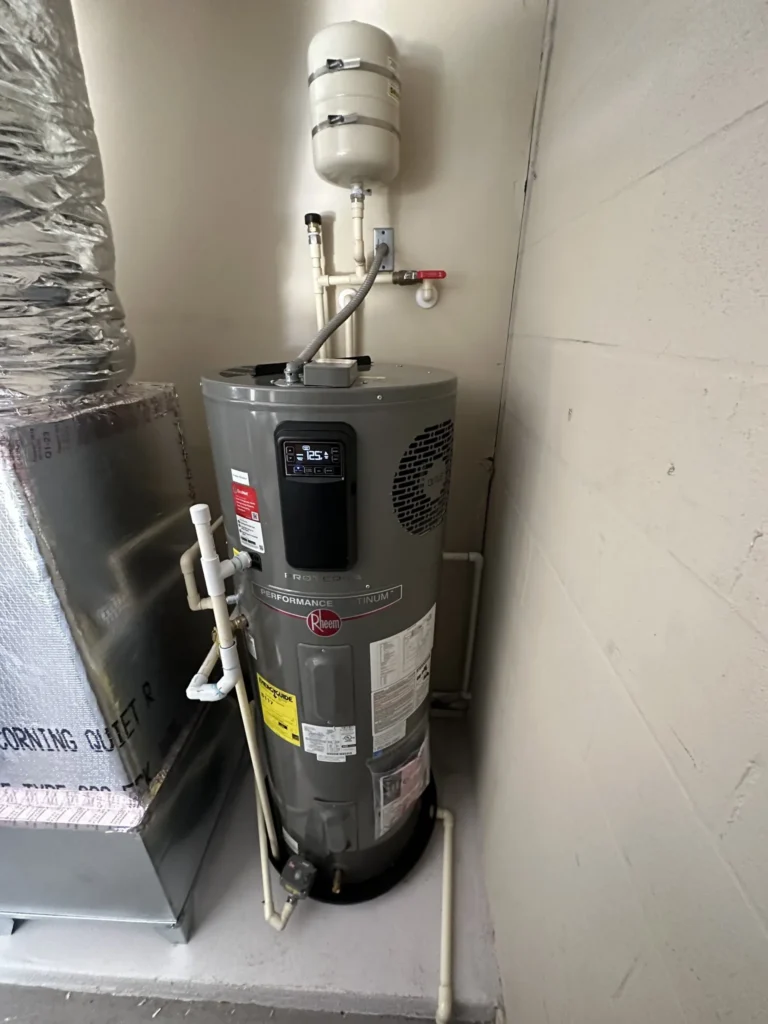
Their garage was a two-car with the water heater in the back corner, nine feet of clearance on every side, and an afternoon temperature that made me sweat through the walk-through. That is the description of a heat pump water heater’s ideal home, and I told them so. An 80-gallon hybrid solved the volume problem outright, ran on the existing 30-amp circuit with no panel work, and, in heat pump mode, used roughly a third of the electricity of the tank in quote two. I had a family on Island Estates share their FPL bills after a similar install, and I wrote that up in the post on whether a heat pump water heater is worth it in Florida. The numbers in that post are the numbers I showed this couple.
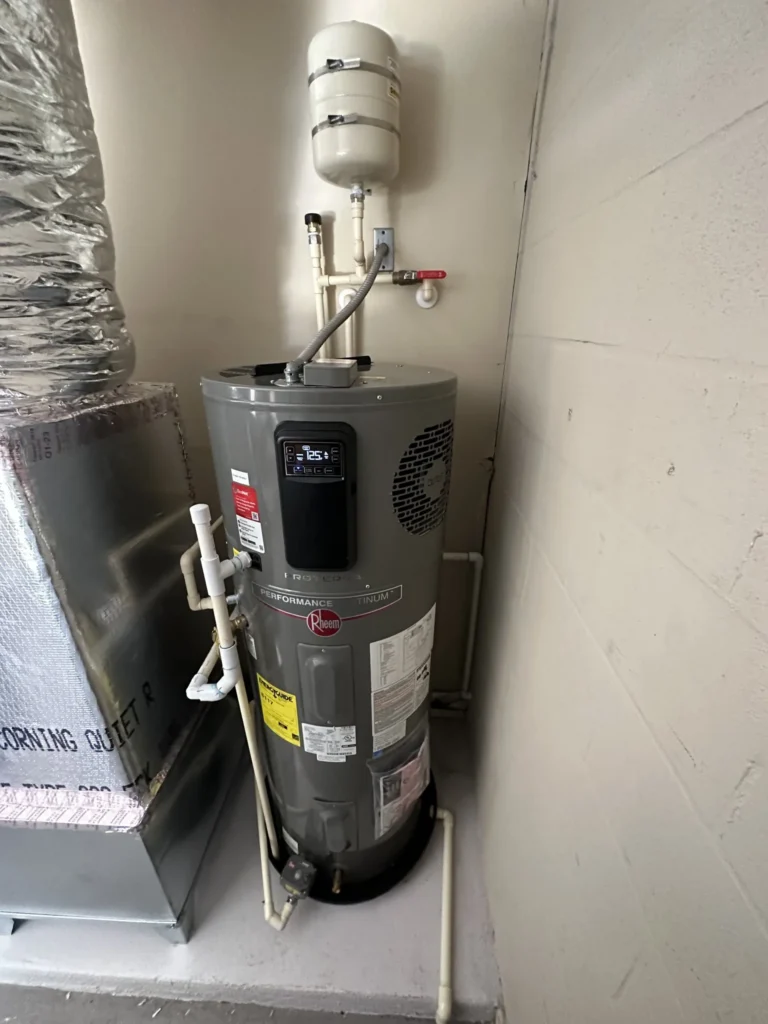
The hybrid quote landed between the other two: well above the plain tank, well below the tankless with the panel. It included the same pan, expansion tank, and condensate line the Island Estates job had. It did not include a softener, because a tank heater tolerates hard water the way a tankless unit does not, though I told them the anode would need attention around year five for the same reason I explain in the post on how long water heaters last in Florida.
The point where spending more stopped making sense
What decided it was not the efficiency. It was the panel upgrade. Once the tankless number included the electrician, the couple could see that they would be paying for an electrical service they did not otherwise need, for a heater that would need a softener and a yearly descale, to get a benefit, endless hot water, that an 80-gallon hybrid delivered in practice for a family of four. Endless and eighty gallons with a fast recovery are different on paper and nearly identical in a house with two bathrooms.
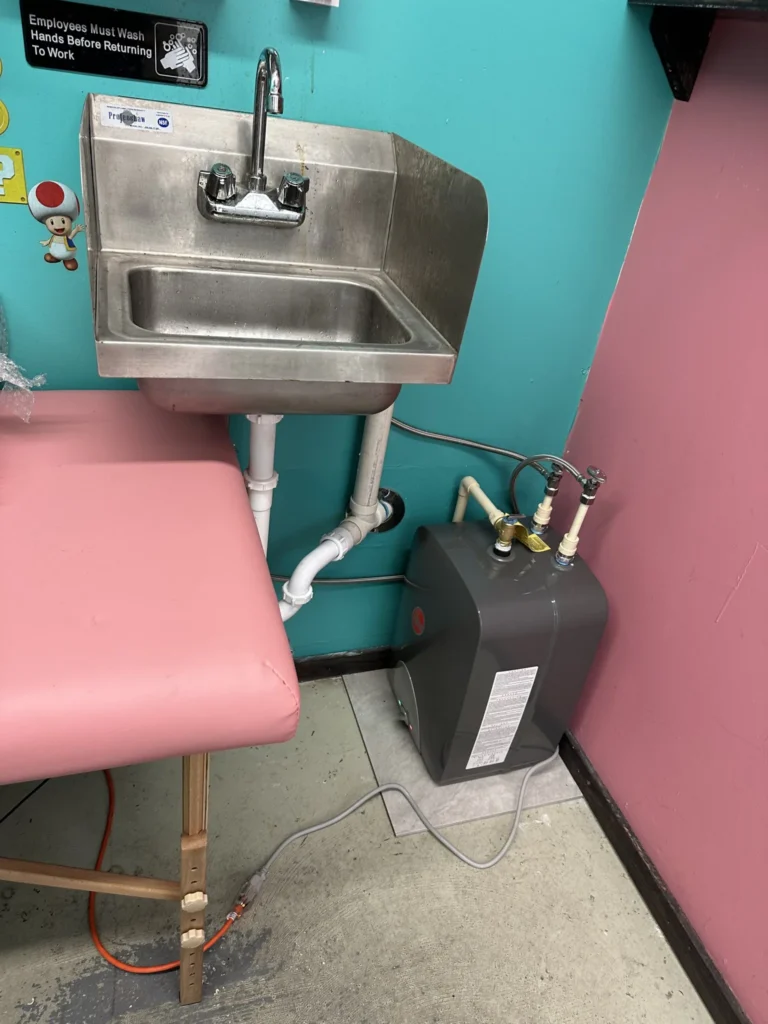
I have installed electric tankless units in Palm Coast and I would do it again in the right house: a small home with a 200-amp panel and a softener already in the garage, a detached studio or an outdoor shower where a point-of-use unit makes sense, or a household of one or two that values the closet space more than the flow. This was not that house.
What people ask when they are weighing this
Do tankless heaters work with hard water? They work until they scale. On Palm Coast water, plan on a softener or a yearly descaling service. Most manufacturers require one or the other to honor the warranty.
What size electric tankless do I need? For a whole house here, 27 to 36 kilowatts, which is 112 to 150 amps at 240 volts. That number is why the panel gets checked first.
Which is cheaper to run, tank or tankless? Electric tankless and an electric tank use the same resistance heating, so the difference is standby loss, which is modest on a modern insulated tank. A heat pump tank beats both by a wide margin in this climate.
What if the current tank is only a few years old? Then the question is not which type but whether to touch it at all, which is the call I walk through in the post on repairing or replacing a water heater that keeps tripping its breaker.
Do I need to upgrade my panel? For whole-house electric tankless, in most Palm Coast homes with 150-amp service, yes. Have an electrician run the Article 220 load calculation before you price the heater.
If the three quotes raise the bigger question of what should be in a Palm Coast garage at all, the full guide built from one week of Palm Coast water heater calls walks it from the rating plate to the invoice.
What I want you to take from their kitchen counter
The rental heater they fell in love with was gas, in a house with a different panel, in a place with different water. None of that transferred. What did transfer was the problem, running out of hot water, and there were three ways to solve it at three prices. The middle one fit their house. Yours might be different, and the way to find out is to look at the panel and the garage before you look at a heater.
If you are weighing a tankless vs tank water heater in Florida, the itemized water heater quote I send shows every option as its own total, including the electrician’s line when tankless needs one. Our water heater installation and repair service in Palm Coast installs all three, and I would rather talk you out of the wrong one than into it.